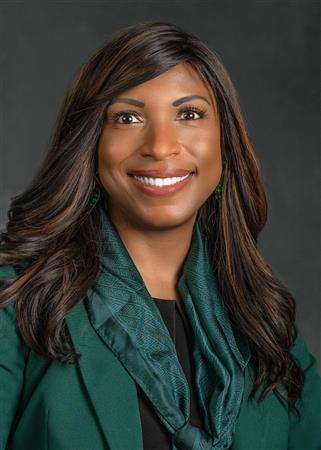
Brianna T. Scott is an attorney/entrepreneur in Muskegon, Michigan. Ms. Scott was elected in November 2018 to an eight-year term to the Michigan State University Board of Trustees, and is currently the Chair. In 2014, Ms. Scott became the first person to serve as president of the Muskegon Rotary Club, and served as the Rotary International District 6290 Governor for 2024-25.
Ms. Scott began her presentation by explaining how Rotary gave her the confidence and skills for what she is doing now with her career. Chairing committees taught responsibility and accountability as you are able to learn from others with different backgrounds. When she served as president for the Muskegon Rotary, a very large club (250 members), this role gave her confidence in public speaking. Attending the PELS conference provided great leadership role models and connections. Ms. Scott indicated that “Rotary is the most beautiful community with all different walks of life you can encounter. ”
Michigan State University is an R1 university, that is, it a top-tier doctoral instituation recognized for high research activity. The state of Michigan has four institutions in this category: Michigan State University, University of Michigan-Ann Arbor, Wayne State University, and Michigan Technological University. The three flagship universitities --MSU, UofM, WSU-- all have eight-member boards elected by voters statewide, serving staggered eight-year terms.
When Ms. Scott was elected to her first eight-year term in 2018, MSU was a “hot mess” during the era of former dean, William Strampel, and the disgraced Dr. Larry Nassar; following in 2019 with John Engler resigining as interim president stemming from controversial remarks about the victims of Nassar and efforts to close a fund for survivor mental health care. The Board of Trustees are not micromanagers. The Trustees are responsible for hiring and evaluating the president of the university, have oversight of a $5 billion budget, responsible for whether or not to increase tuition, approve/sign union and staff contracts, and are responsible for mitigating all of the liabilities for the university to make sure there is compliance for students, staff, faculty, and the dean. MSU features 17 degree-granting colleges with over 400 programs of study. As a result of the Strampel/Nasser fiasco, the Board of Trustees became aggressive in making sure that all investigations are done procedurally and timely under Title IX, following all the rules of federal funding requirements. Every report of investigation at the college is reviewed by one assigned trustee and the college president, and the entire investigation is followed up to the point of a finding being rendered and assuring that the finding is carried out. The Board of Trustees is now accountable for knowing everything that is happening in the university. This process has narrowed the amount of lawsuits, wherein over $400 million was paid out in 2018 to the survivors of Dr. Nassar.
Ms. Scott explained that suicide is still a problem, not only at MSU, but all universities. MSU has a suicide prevention research center funded by a $15 million grant from the National Institutes of Mental Health. The Board of Trustees has recommended that MSU provide more counseling and health wellness programs for students, staff, and faculty, and takes a more holostic approach to these experiences on the campus. As a result, there has been a significant decrease in the amount of emergency situations.
MSU is the nation's first agricultural college as a result of a land grant, that is, it is an institution designated by state legislature to receive federal funding under the Morrill Act of 1862 and 1890 to focus on practical education in agriculture, science, military science, and engineering. The theory of the land grant was to provide education to the common folk and to aid in the economic boom. MSU has one of the largest agricultural programs to provide research for farmers, and the Michigan Farm Bureau was founded at the college in 1919. MSU Extension is an outreach program that brings trusted, research-backed knowledge to everyone in the state of Michigan as there is an extension office in every county. MSU has the Spartan Tuition Advantage program that is a financial aid program that covers up to 18 credits of tution per semester for qualifying full-time, in-state students through a combination of federal, state, and institutional gift aid. Because of this land-grant based program, over 68 percent of MSU graduates stay and continue to work in Michigan.
Though MSU started as an agricultural college, it actually offers premier health education through specialized colleges, including veterinary medicine, osteopathic medicine, human medicine, and nursing. The Board of Trustees looked into efficiency in providing these programs, and the “One Team, One Health” initiative that was created by the Health Sciences Council appointed by current MSU President, Dr. Kevin Guskiewicz, was formed. As a result, all the medical programs are more beneficial to the constituents and provide a better education to the students. Ms. Scott mentioned that there is nothing more important on a college campus than to have diversity of thought, sharing ideas, and to provide safe space and programming.
To view a recording of Brianna's presentation, access the Club's unlisted YouTube channel by clicking the following link: https://youtu.be/PPKDiqIUQp0